
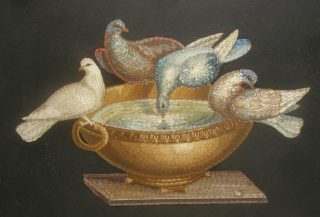
Greetings Jon from Old Tappan. I am an avid reader of your column each week. So much so that I have to drive to Pearl River to pick up the paper, as we do not get the Rockland County Times in New Jersey. You recently did an informative appraisal relative to an inlaid stone box that you explained is called Pietra dura. We have a beautiful family heirloom wall hanging, that we were always told was this Pietra dura. As you can see it’s a scene of pigeons drinking water. However, since reading your article and comparing the pictures of the item you appraised in that article, I’m not so sure anymore. Perhaps there are several different types of Pietra dura? I have sent you close up pictures of our item for you to study. Please enlighten us so we can finally, definitely know what we have. Can I also request the value? I hope this question gets published so your readers can see what I’m referring to. Thank you, Jon, for your help.
Brian F.
First, I thank you for your efforts to obtain this newspaper and read my article each week. I’m glad you enjoy it. To answer your question and clear up any confusion; what you possess is not Pietra dura decorated. You have a beautiful Grand Tour Italian tesserae micro mosaic plaque depicting a central image of four doves, not pigeons, around an ornate basin, known as the “Capitoline Doves” or the “Doves of Pliny.” Your plaque dates from the third quarter of the nineteenth century. Each dove is seated upon the edge of a two handled gold basin of water, that rests above a square plinth base, against a black slate background. When I use the term tesserae micro mosaic, I’m describing mosaics made of tiny pieces of stone or glass that are cut into regular or irregular shapes. These individual pieces are carefully arranged and set in a matrix, typically cement, to form intricate pictures, patterns or designs. The small, unified pieces whether cubes, squares or other forms, collectively create a larger, unified image. Some micro mosaics contain thousands of pieces per square inch. Some of inferior quality reveal visible small spaces between the pieces This is the reason each micro mosaic plaque must be carefully examined individually. I am delighted to inform you that your particular micro mosaic plaque does not suffer from inferior workmanship. In fact, your plaque is among the finest I’ve encountered. Very high-quality design and a tight realistic image. Another positive point I would like to bring to your attention is that the image appears to be mounted in the original carved acanthus gilt decorated wooden frame. Collectors desire everything original. This will add to its value. Both the plaque and the frame appear to have remained in excellent condition, no damage noted. It is my opinion that a current replacement value for this antique micro mosaic plaque is $3,000 USD. A brief explanation of the term Grand Tour and “Capitoline Doves.” A Grand Tour antique is an artifact or artwork collected by wealthy Europeans during the traditional “Grand Tour “education trip through the classical sites of Europe, primarily Italy and Greece during the nineteenth century. Your image of these particular doves originated from a Roman floor decoration discovered in the 18th century in the town of Tivoli. This in turn was believed to be a rendering of a lost ancient Greek mosaic at Pergamon. I did some research and found this image is actually described by the Greek historian Pliny in his “Natural History” that was believed to have been completed sometime around 75 AD. I trust this will now clear up any confusion that existed relative to the difference between Pitera dura and micro mosaic decoration.

RZM Fine Arts and Antiques Inc: Ask the Appraiser added by rctadmin on
View all posts by rctadmin →
You must be logged in to post a comment Login