
He is Rockland County’s most remarkable and influential resident of all time. Indeed, there was a period when he was the most well-known and popular of all living Americans, when his picture adorned the walls of thousands upon thousands of homes. Counties, cities, and towns in at least 15 states are still named after him, as are scores of mountains, rivers, valleys, and islands, not to mention dozens of schools and uncounted streets nationwide, including one in Nanuet. However, based upon a recent random sampling locally, the memory of John C. Fremont who has been resting in peace as a Permanent Resident on Mount Nebo in Sparkill’s Rockland Cemetery for over 130 years, is all but forgotten.
It is fair to say that more than any other person, he transformed the United States from a country whose population was clustered east of the Mississippi River into one that stretches from sea to shining sea. Widely known by the moniker The Pathfinder, as a young Army officer in the Corps of Topographical Engineers (similar to today’s NASA, the National Aeronautics and Space Administration), he led expeditions from Missouri to the Pacific Ocean in the early 1840s, traversing territory that today is familiar and safe but which, at the time, was almost completely unmapped and fraught with mortal danger. He charted passable routes that became known as the Oregon Trail, which made it possible for Easterners in their Conestoga wagons to migrate to America’s western lands. In addition, he carefully studied the flora and fauna wherever he went, first documenting and then spreading the word to the public about the vast natural resources and tremendous, but yet untapped, agricultural potential of the land.
John C. Fremont was born in Savannah, GA in 1813, the love-child of a sophisticated and educated but unmarried couple. A precocious lad, his intelligence became apparent at an early age, and he caught the attention of a number of well-connected individuals. These relationships opened up opportunities that made it possible for him to develop broad scientific knowledge in the areas of topography, mathematics, astronomy and botany, as well as the practical experience and skills needed to survive in the wild. The frontier was his classroom.
John grew into an extremely ambitious and resolute man who was bestowed with immense courage, flexibility, and the seemingly endless fortitude that made it possible for him to persevere and adjust in unpredictable situations. In the end, John C. Fremont lived the life of adventure and accomplishment that others could only dream of.
Following his expeditions, John needed someone who could simplify the highly detailed and technical aspects of the reports that he submitted to the Army in order to publish versions that were more suitable for general consumption. The public oriented books related stories of the challenges, excitement and adventures Fremont experienced. They also contained condensed formats of the scientific data and practical knowledge that he had gathered along the way. That person, his trusted collaborator and alter-ego, was his wife, Jesse Benton Fremont. This talented wordsmith was herself the daughter of a Senator from Missouri who was a great proponent of America’s western expansion. Jesse’s contribution was essential in boosting her husband’s reputation and expanding his influence upon the public. The books that they co-authored became nationwide best-sellers whose effect would alter the course of American history.
At the time of Fremont’s first expedition to the Pacific, there were roughly 500 Americans inhabiting what then was known as the Oregon Territory, a disputed area that was claimed by both the US and Britain. It encompassed not only the current state of Oregon but also the totality of the states of Idaho, and Washington, as well as large swaths of the states of Montana, Utah and Wyoming. No navigable overland route from the Mississippi River to the West Coast existed, making travel to this area by land next to impossible.
In 1844, James Polk ran for president under the campaign slogan “Fifty-four Forty or Fight!,” indicating that if elected he was intent on bringing the Oregon Territory into the union, even if it meant going to war with England. Following the publication of the report of Fremont’s Expedition to the Pacific Northwest in which he charted a detailed route known as the Oregon Trail, the public was infected with “Oregon Fever”, spurring thousands of hardy souls, commonly known as pioneers, to make the journey to settled there. With the resultant influx of Americans populating the area, England relinquished its claims to most of the Oregon Territory, thus averting a war. What’s more, his expeditions and the subsequent best-selling reports brought about a great rise in population into what was to become the states of Nebraska, Kansas and Colorado.
Early in 1846, on secret orders from President Polk, Fremont was sent to California, then a Mexican territory, to foment what would become known as the Bear Flag Revolt. He organized and led a small band of American settlers who defeated a Mexican army garrison in Sonoma. In the wake of this victory, on June 14, 1846, the independent nation known as the California Republic was declared. It was to last less than a month.
Commodore John Sloat (who was born in Sloatsburg, Rockland County), upon being informed that the US was at war with Mexico, took his fleet into Monterrey Bay on July 7. Two days later, he lowered the flag of the nascent California Republic and raised the Stars and Stripes, declaring California as part of the US.
Here is an abbreviated list of John C. Fremont’s subsequent accomplishments:
- He was the first Military Commandant, and First Civil Governor of the territory of California.
- He was the first Senator from California to sit in the US Senate.
- So great was his popularity and fame, that in 1856 he was the first Presidential Candidate of the Republican Party. Prior to accepting the candidacy, he was also offered the candidacy of the Democrat Party but turned it down. John was a staunch abolitionist, and he was unwilling to support the Democrats’ pro-slavery platform.
- Despite losing the 1856 election to James Buchanan, he was offered the Republican Party’s candidacy in 1860. He decided to no longer continue in politics and rejected the offer. In his place, the Republicans nominated Abraham Lincoln.
- During the Civil War, Fremont assumed the rank of Major General and was given command of the Army of the Western Department. He unilaterally and without permission issued an Emancipation Proclamation freeing the slaves in Missouri which led to his being relieved of command by President Lincoln.
- During the California Gold Rush, he made an enormous fortune when gold deposits were found on property that he had purchased. Unfortunately, John was not an astute businessman and would lose his wealth due to speculative investments that went bust. But before that happened, he owned a beautiful estate named Pokahoe, nestled on the shores of the Hudson River in what is now Sleepy Hollow, NY, where he and Jesse lived for ten pleasant years following the Civil War.
- He was the first Territorial Governor of Arizona.
- John and Jesse lived in Rockland County for a short while, according to Isabelle Savelle, the former chief historian at the Rockland Historical Society,
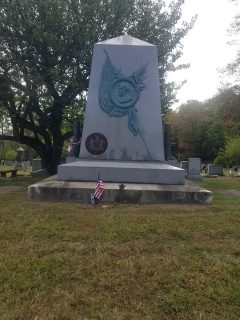
On April 28, 1890, while on a business trip in New York City, John suddenly passed away and was temporarily interred in Manhattan’s historic Trinity Church Cemetery. Jesse, who was living in Los Angeles, could not afford to have his remains transported back to California, so he was brought to Rockland Cemetery in Sparkill for burial.
According to the bible, Moses led the Israelites to the Promised Land, which he himself was forbidden to enter. He was only able to view it from afar, from Mount Nebo, where he died and was laid to rest. Is it not a fitting coincidence, therefore, that John C. Fremont, America’s Great Pathfinder, lays buried on Mount Nebo in Rockland County, far from the majestic mountains, the fertile valleys and fruited plains of America’s West of which he, more than anyone else, made mass settlement a reality?
Some years later, Jesse died, and her ashes were brought from California to Rockland and laid to rest beside her beloved husband on Mt. Nebo. In 1911, a granite monument, some 10 feet tall, was erected beside his grave by the State of New York. With time, other family members joined them on Mt. Nebo, including their son, Admiral John C. Fremont Jr., and grandson, Capt. John C. Fremont III, US Navy.
Although his photo may no longer hang on the walls of his countrymen’s homes, and his memory has been largely forgotten, the accomplishments of John C. Fremont still reverberate and remain relevant. Jesse Benton Fremont best summarized the effect her husband had on the nation when she wrote, “… roads followed the lines of his journeys, and cities have risen upon the ashes of his lonely campfires.”
We all owe him a debt of gratitude. Let us not allow the memory of America’s Pathfinder to remain forgotten.

Our Forgotten But Notable Neighbors: John C. Fremont added by Jerome Kleiman on
View all posts by Jerome Kleiman →
You must be logged in to post a comment Login