
Good morning Jon, my name is Sandra. I’m sending you pictures of a very old knife that belonged to my father when he was alive. He never told us any information about it other than he acquired it in Europe during World War I. My father lived to be 103, and was one of the last surviving World War I veterans in New York state. Though he is deceased many years now, I still have this knife. I am on my own now, and getting ready to move, so before I give it away to perhaps a family member, I would like to finally come to the knowledge of what it is and does it have any monetary value to a collector? It has a beautiful stone of some kind on the handle. Three of my relatives want this knife, as I am being constantly reminded and reminded. I do want to make everybody happy. I value your opinion as to what I should do. I am an avid reader of your article and will certainly miss reading it when I move.
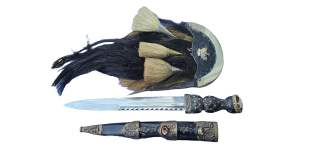
The ornate “knife” that you are inquiring about is actually a 19th century Scottish Dirk, with its original highly decorated scabbard. Daggers and knives have been a part of civilian wear and military dress since the first knives were crafted from stone. A few cultures throughout history have taken this utilitarian tool and really turned it into an item of great cultural significance. Your dirk, as developed by the Scots, is one of these weapons.
What is a “dirk” you may ask. At its most basic; a dirk can be defined as a long dagger with a straight blade. This very loose definition covers many different kinds of knives and edged weapons. In fact, most daggers will fit within this definition. Your Scottish dirk, however, has unique features that set it apart from other straight-bladed sidearms. The first being that “beautiful stone” you mention on the handle. It’s actually a highly polished citrine stone mounted on the pommel, which is what the top of a dirk is called. Next, if you closely examine the scabbard you will observe, nicely etched along the side; 81st Inf., possibly signifying the 81st Highlanders Regiment. The ricasso section of the forged steel blade is maker marked: HAMILTON CRIGHTON & CO. EDINBURGH. Both the dirk and the scabbard are crafted in a beautiful black leather and lavishly decorated with bronze bands of embossed thistle. The scabbard even retains the original matching small fork and knife. Most of the time, one or both of these accoutrements are missing. Lost to time, if you will. This particular style weapon saw service during the Second Boer War (1899). That being said, it was a long time before your father acquired it, perhaps in Europe during World War I. How and if your father actually did get this item during the first world war is anyone’s guess. What is for certain is that you own a high quality antique Scottish Highlander’s dirk that has remained in absolutely pristine condition and that has a current market value of $4,000 USD. To reference your question regarding what to do with this item in order to keep everybody happy, you mention that there are three relatives that want this knife. Obviously it can’t be split in three pieces. Situations like the one you’re now experiencing occur frequently with the delicate matters of settling estates. I’m all too familiar with this situation. The only answer? The item gets sold and the funds paid are divided up three ways. Please realize you own a very desirable dress dagger that edge weapon collectors would want in their collection. Should you decide to sell, my recommendation is that it should only be sold through a military auction that specifically deals in arms and armor. In that venue, this wonderful item will get its best audience. My best wishes to you in your future residence.

RZM Fine Arts and Antiques Inc: Ask the Appraiser added by rctadmin on
View all posts by rctadmin →
You must be logged in to post a comment Login