
Good afternoon, Jon. I have a favor to ask of you. Our next-door neighbor recently passed away and since she had no family still living, I am now the Executor of her estate. The item I have photographed for you to evaluate was found on the shelf of a closet. In fact, we almost missed it. When we ran an estate sale at her house last week, literally six different people attending the sale wanted to purchase this item in the worst way. Two ladies literally almost got into a fight over who was going to purchase it. Quite upsetting. So, I pulled it out of the sale and decided to contact you. My request is that you tell me how much value this item has and exactly what it is. Honestly, it doesn’t look like something of value to me. At the estate sale, my wife had a price of $20.00 on it. But when one of the ladies, during the heated argument offered $200, I figured this thing might be something of value. This lady was very insistent and returned a half hour later and made us a $400 offer. She said she was a collector and that she was now over-paying, but that she really wanted it for her collection. I’ll be honest, I wanted to sell it at that point, however my wife wouldn’t let me. She told the lady it was no longer for sale. The lady became quite angry and finally left. My wife said she wanted to check with you before letting it go and wished you were with us at the estate sale! Do you ever run estate sales?
Glen
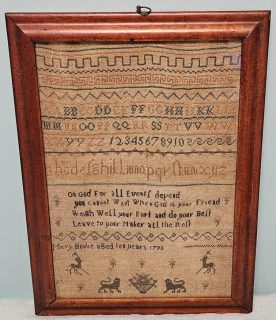
No more estate sales for me Glen. I’ve had more than my share of conducting estate sales. Let me explain the reason why these folks were so aggressive regarding the purchase of this particular item. The item in question is a rare 18th century American Sampler. It is desirable for a number of reasons. The primary reason, as stated, is that it is from the 18th century. You can see the date of 1775 stitched at the bottom. 18th century samplers are generally of substantially more valuable than samplers dating from the 19th century. In general, the more pictorial a sampler is, the greater the value. For example, samplers that display houses, animals, people and flowers will command higher prices. Your example has all the bells and whistles that collectors look for. Another interesting fact about this sampler I would like to point out – please take notice of the alphabet on your sampler. It does not contain the letters “J” and “U” because those letters were not part of the early Latin alphabet. So, the letter “I” was used for “J” and the letter “V” for “U.” Now I will explain exactly what a sampler is. In its most basic form, samplers are a form of embroidery that evolved in the 17th century used to demonstrate needlework skills. Most commonly, samplers are stitched by children, using silk or wool thread, onto a canvas background. From the early 1700’s samplers were worked by young women to learn the basic needlework skills needed to operate the family household. The earliest known American sampler was made by Loara Standish of the Plymouth Colony sometime around 1650. In the past, collectors overlooked samplers as ordinary exercises in needlework, but today they are highly collectible and can command extremely high prices. They are now considered works of art and a glimpse into the past. Your sampler is a wonderful early example that meets all the requirements to potentially sell at a well-advertised Americana auction for $12,000 USD. I’m basing this appraisal on comparable examples recently sold at important Americana auctions in the last three years. Your sampler has appeared to have remained in excellent condition, still maintaining wonderful colors, all contained within the beautiful original burl walnut frame. A rare American 18th century example with no damage or restoration. A word about the colors in this sampler. The natural dyes used offer harmonious colors that have mellowed with age. Natural dyes fade to softer, lighter tones while remaining true to their original color. Synthetic dyes can fade unevenly, resulting in blotchy areas that can fade completely. You were quite wise to have listened to your wife and not sell this important item at an estate sale venue. Please thank your wife for being a regular reader on this column.

RZM Fine Arts and Antiques Inc: Ask the Appraiser added by rctadmin on
View all posts by rctadmin →
You must be logged in to post a comment Login