
In front of the main entrance to the Rockland County Courthouse, there is a monument honoring those county residents who made the ultimate sacrifice for their country. Included, chiseled in stone, are names of 240 Rocklanders who died during World War II. When the project to build this monument commenced in 1988, Jerry Donnellan, Rockland’s late advocate for veterans declared, “Anyone who is going to pay the ultimate price should have their name up here.” Requests were made to the public to submit names of people from the county who died defending the country. However, upon completion, one name which belongs on the WWII list was omitted – Private Murray Gottlieb.
By the time the Memorial project was underway, nearly half a century after his death, all of Murray’s close relatives and friends, the people who knew him best, were themselves either dead or had moved away from the area. Hence, this might explain why his name was not submitted for the project.
Sadly, we now know more about Murray Gottlieb’s death than his life. Nobody is still around who would remember him, so we have to rely on a few available newspaper articles and census data to build a picture of who he was.
We do know that he spent his formative years in Spring Valley, and that he was just 24 years old when, on October 24, 1944, his short life was brought to a close. He lived in Yonkers with his parents and younger sister for the first few years, until his father passed away. His mother Esther, a young widow, was matched with William Sarafan, a fellow widower from Spring Valley with two daughters. The two were married, forming a Brady Bunch type of family with four children, Murray included, and settled down in Spring Valley. An additional daughter was added after a few years. Nothing out of the ordinary seems to have occurred with the Gottlieb-Sarafan clan. Murray was apparently an excellent student. There’s a newspaper article from 1930 in which he is listed amongst the top academic achievers in the 5th grade in Spring Valley’s North Main Street School.
We do know that William Sarafan was a religious Jew, who at times was the president of Spring Valley’s Congregation Sons of Israel Synagogue. Therefore, we can conclude that Murray celebrated his Bar Mitzvah there.
During this period, the local, day-to-day aspects of life in Rockland and all of America were increasingly affected by events taking place thousands of miles from our shores. Although America was still officially at peace, as the 1930s transitioned into the 1940s, ominous clouds of war loomed on the horizon. Bloody conflict had already been raging in Europe and Asia for several years, and the momentum was with the armies of Germany’s Hitler and Japan’s Hirohito.
As the prospects of America being drawn into war grew, 20-year-old Murray enlisted in the Army. He was assigned to a B-17 bomber support unit in the Army Air Corps, and after training sent to the Philippines in October 1941. Less than two months later on Dec. 7, and just several hours after the attack on Pearl Harbor, the base near Manila where he was stationed was attacked by Japanese planes, causing severe damage to U.S. air power and inflicting hundreds of casualties. The bombers that Murray’s unit was supposed to service were largely destroyed, and therefore, he was converted into an infantryman who, in all likelihood, took part in battles against the Japanese in the jungles of Bataan. The fighting would rage on for four months, but in the end the lack of sufficient food, medicine, and ammunition forced the U.S. troops to surrender.
Gottlieb and the other U.S. troops, many of whom were already ill from the effects of starvation, malaria, dysentery, and other similar diseases, were forced to march 100 kilometers in the extreme heat of the Philippines. Now known as the Bataan Death March, over 10,000 U.S. troops, Americans and Filipinos, died along the way. The Japanese withheld food and refused to allow the marchers to drink from streams or artisan wells, and bayoneted, shot or decapitated anyone who was unable to keep up with the other marchers.
This was only the beginning of Murray’s and his fellow soldiers’ Saga of Suffering.
Murray would spend the next 30 months in Prisoner of War camps where forced labor and malnutrition were the bywords. During the first six months alone, over 5,000 American and 26,000 Filipino POWs died.
When the war broke out, General Douglas MacArthur was the commanding officer of all U.S. troops in the Philippines, but in early 1942 he was ordered to go to Australia to command the Allied forces in the Southwest Pacific. Upon arriving in Australia, General MacArthur made the famous statement, “I Shall Return”.
After two and a half years of furious fighting, MacArthur and his troops returned to the Philippines on October 20, 1944. Before they could be rescued, 1,800 American Prisoners-of-War, including Pvt. Murray Gottlieb, set sail from Manila Harbor for Japan aboard a rusty, old Japanese freighter named the Arisan Maru. At the point of a bayonet, the POWs were herded deep down into the unlit bowels of the ship, where they were packed so tightly that they had to take turns sitting.
To be continued in next week’s edition of the Rockland County Times
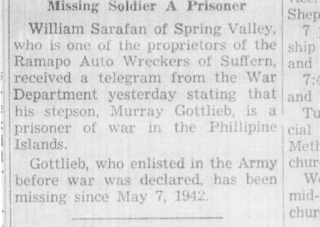

Our Forgotten but Notable Neighbors: Pvt. Murray Gottlieb, Part One added by Jerome Kleiman on
View all posts by Jerome Kleiman →
You must be logged in to post a comment Login