
Part Two, continued from the 02.26.26 edition of the Rockland County Times
After two and a half years of furious fighting, MacArthur and his troops returned to the Philippines on October 20, 1944. Before they could be rescued, on that very same day, 1,800 American Prisoners-of-War, including Pvt. Murray Gottlieb, set sail from Manila Harbor for Japan aboard a rusty, old Japanese freighter named the Arisan Maru. At the point of a bayonet, the POWs were herded deep down into the unlit bowels of the ship, where they were packed so tightly that they had to take turns sitting.
For several days as the ship sailed north, the POWs were given only three small balls of rice and several tablespoons of water daily. Arguably, even worse than the starvation was the lack of sanitary facilities. The holds in which the men were imprisoned lacked the necessary equipment to dispose of human waste, and were essentially large sewage tanks. Due to such inhumane conditions, the Japanese ships used to transport POWs were known as Hell Ships
By this time in the war, it was very dangerous for the Japanese to sail from the Philippines to Japan, as the U.S. Navy controlled the shipping lanes. Within these lanes were U.S. submarines, prowling the waters searching for enemy ships to sink.
And then it happened. On October 24, 1944, some 200 nautical miles off the coast of China, two torpedoes from the submarine The USS Shark, hit the Arisan Maru, splitting it in two. The crew members were able to board lifeboats to reach nearby ships in the convoy. Before abandoning ship, the Japanese locked the hold covers to prevent the POWs from escaping. Luckily, the Americans were able to open the hatches, allowing those not killed or severely wounded to climb out of the holds. But with no rafts, lifeboats or other safety implements remaining, many of those men resigned themselves to going down with the ship. Some jumped in the water in attempts to grab on to floating paraphernalia. Some were able to swim to a nearby Japanese ship, but were pushed away, back out to sea. In the end, only eight men out of 1,800 survived the ordeal. Pvt. Murray Gottlieb was not one of them. The sinking of the Arisan Maru is the largest maritime disaster in American history.
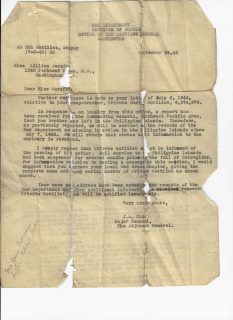
Several months later, a messenger delivered a telegram to Murray’s family from the Army informing them simply that their son had been killed-in-action. But the gruesome circumstances surrounding his death, intentionally suppressed by the government, were withheld.
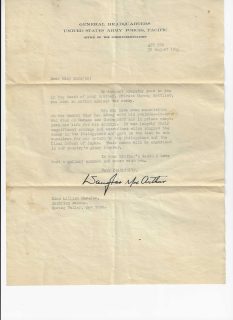
Just three days before the official surrender of Japan on the USS Missouri on August 30th, 1945, General Macarthur wrote a personal letter to Lillian Sarafan, Murray’s stepsister. In this letter, Murray expressed his deepest sympathy for the family’s loss. But again, the details surrounding Murray’s death were not mentioned.
It was not until 1983, when a newspaper article based on an extended conversation with four of the eight survivors of the Arisan Maru fiasco was made public, that the American people finally learned the full story about the death of Murray Gottlieb and the other POWs.
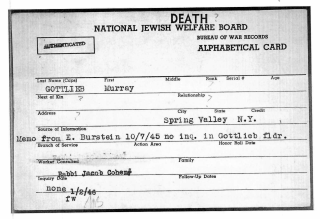
Late in 1945, shortly after the end of the war, a ceremony was held at Congregation Sons of Israel commemorating Murray and four other Jewish soldiers from Spring Valley, all of whom lost their lives during the war.
Recently, I spoke with one of Murray’s nephews, himself a former combat medic in Vietnam. He stated that his mother, now long gone, had never mentioned Murray to him. Murray’s nephew had no idea that he had an uncle who had fought in the Philippines and had experienced the Bataan Death March and POW camps, nor did he have any idea that his uncle had died on a Hell Ship. He surmises that the pain his mother experienced from Murray’s loss may well have been so profound that she could not bring herself to mention him to her children.
While Murray was still classified as Missing-in-Action, his mother, Esther Sarafan, passed away. Barely into her 40s, it seems possible that her worry about Murray’s disappearance may have played a role in her early death.
Since the sinking of the Arisan Maru, Pvt. Murray Gottlieb’s official status with the Army has been “UNRECOVERABLE”. This means that his physical remains will forever remain hidden somewhere in the deep, cold waters of the North China Sea.
With time, memories evaporate, yet time cannot be allowed to dim the glory of Murray and the others like him, who fought, suffered and died, so far away from home, so long ago, in wars now barely remembered. Nonetheless, we, the living beneficiaries of their bravery and sacrifices, have a timeless obligation to honor them.
It would be fitting to bring Pvt. Murray Gottlieb’s memory back from the depths of oblivion and to bestow upon him the honor due him, honor that he earned, and honor that he still rightly deserves. Propriety demands that the name of Private Murray Gottlieb be added to Rockland County’s Memorial Wall so that he no longer be forgotten.

Our Forgotten but Notable Neighbors: Pvt. Murray Gottlieb, Part Two added by Jerome Kleiman on
View all posts by Jerome Kleiman →
You must be logged in to post a comment Login