
On Friday, March 13, more than 3,200 community members gathered at the Rockland Community College Fieldhouse to advocate for the rights of individuals with intellectual and developmental disabilities (IDD) at Jawonio’s third annual “Rally in the Valley.” Speakers emphasized the importance of a 4% increase in funding for direct support professionals (DSPs) to keep up with inflation, ensure sustainable wages, and the importance of maintaining vital programs such as Medicaid.
Jawonio hosted 30 different agencies supporting individuals with IDD from out in Long Island to upstate in Sullivan County. Randi Rios-Castro, CEO of Jawonio said, “When you look around today, you see something powerful. Families, advocates, providers, community members, and people with disabilities standing shoulder to shoulder, [all] here because we believe that disability rights are human rights.”
“Invest in people. Invest in our workforce, and protect service for people with disabilities,” continued Rios-Castro.
Elected officials from both parties gathered for the cause, including Congressman Mike Lawler, Senator Bill Weber, Rockland County Legislator Beth Davidson, Senator Shelley Mayer, Senator Pete Harper, Senator Rob Rolison, Assemblyman Patrick Carroll, and Assemblyman Aron Wieder.
Diana Hess, Chief Communications and Development Officer for Jawonio, was Emcee and co-organized the event alongside Audra Morrison. Hess said, “We want to protect the people who need it most. Advocacy for those who need it should ideally happen year round, not just wait till the last minute.”
Speakers also emphasized the importance of protecting immigrant workers, including the many Haitian immigrants who work as DSPs. Legislators pledged support for these workers and recognized the critical role in supporting individuals with disabilities. In his speech, Lawler stated, “We in Rockland County know how critical our Haitian workers are. They are an essential part of our community, our workforce, and they should not be forced to go back to Haiti.”
The New York State budget is due April 1st, a mere three weeks from the date of the rally. The state has proposed a 1.7% funding increase, which advocates deem insufficient. According to the members of the State Senate and Assembly who attended the rally a 4% increase would be the magic number to adequately address rising costs and workforce shortages.
In New York, Article 16 of Public Health Law governs services and programs for people with developmental disabilities, ensuring that agencies providing care meet state standards. Similarly, Article 28 regulates and licenses medical facilities, including hospitals, nursing homes and diagnostic centers, which is supervised by the New York State Department of Health. Speakers declared that an increased budget would ensure that these facilities are better able to meet these standards.
Michael Seereiter, President and CEO of New York Alliance for Inclusion and Innovation, emphasized the importance of the work that DSPs accomplish, stating, “Home and community-based services are critical to enabling people with IDD to live full and independent lives in our communities.” Unfortunately, many DSP’s work two or three jobs in addition to being a full-time care provider just to make ends meet.
According to the Schuyler Center, recent reports indicate that New York ranks among the lowest in the nation for the timely delivery of Early Intervention (EI) services for infants and toddlers with developmental delays. Vice President of Cerebral Palsy New York, Karly Smelson, said, “New York is in a capacity crisis. We are ranked 48th in the nation for meeting our legal obligations to infants and toddlers who need EI services. 48th in the nation — that is a shameful ranking…”
Self‑advocate Katy Sanchez with ARC Rockland shared her personal story of the impact her caregiver Abigail has had on her independence. With Abigail’s support, Sanchez stated that she has been learning how to manage her own schedule, how to cook, how to keep her space tidy, and the skills to maintain a job at Stop & Shop. “Because of [DSPs], we can live our lives in the community,” Sanchez said.
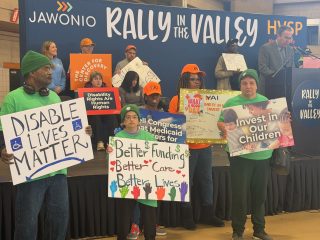

Rally in the Valley Draws Over 3,000 added by Gillian DeStefano on
View all posts by Gillian DeStefano →
You must be logged in to post a comment Login