
Opinions are split on the latest mode of transportation to hit the streets
If you live in Rockland, there’s no doubt that you’ve seen or come in uncomfortably close contact with a child whizzing down the street riding their electric bikes or scooters. While it’s great to see kids enjoy the outdoors, concerns about safety for drivers and bike riders have been surfacing on FaceBook groups and Town Hall meetings.
What was intended to be a convenient and eco-friendly form of transportation has quickly become a source of tension among residents. As e-bikes surge in popularity, confusion over their classifications and capabilities has created growing safety concerns, especially as younger riders take to increasingly powerful machines.
While many riders use low-speed, pedal-assist bikes for transportation or exercise, others, often teenagers, are operating high-powered electric vehicles that more closely resemble motorcycles than bicycles. The result is a clash between accessibility and public safety.
This debate came to the forefront on March 24, when the Town of Orangetown hosted a public discussion about e-bike use, particularly along the Rail Trail in Tappan. Dozens of residents gathered to voice concerns, with opinions divided.
Understanding the issue begins with understanding the bikes themselves. E-bikes are generally divided into three classes: Class 1 bikes provide pedal-assist up to 20 miles per hour; Class 2 bikes include throttle assistance but are also capped at 20 mph; and Class 3 bikes offer pedal-assist up to 28 mph. However, many of the vehicles causing concern locally far exceed those limits.
“These aren’t really bicycles anymore,” said Andrew Ratnecht of Valley Cycle Shop. “They pretty much just slap a set of pedals on it to call it a bicycle, but if you took those off, it’s basically an electric moped.”
According to Ratnecht, some of the more powerful models, often purchased online, can reach speeds of 30 to 50 miles per hour or more, blurring the line between e-bike and motorcycle. “If I took a dirt bike and rode it on the street, I’d get pulled over,” he said. “They need to start enforcing [the same laws] with these.”
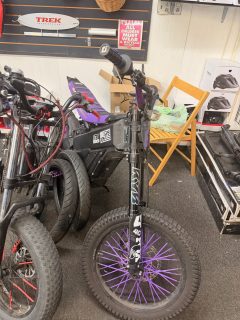
Much of the concern centers around younger riders. High-powered bikes with strong acceleration are becoming a favorite of teenagers, raising alarm among both residents and bike professionals. “Putting a 13-year-old on a bike with that kind of torque, that’s not safe,” Ratnecht said.
Medical professionals in Rockland are also seeing the impact firsthand. According to Liliana Delgado, Trauma Program Director at Montefiore Nyack Hospital, injuries related to e-bikes and e-scooters are rising, and becoming more severe. “At our hospital, we see a clear seasonal pattern, with most injuries occurring between May and September,” Delgado said.
In 2025, the hospital treated five e-bike-related injuries, compared to none the previous year. While many cases involved abrasions and mild concussions, more serious injuries, including fractures, have also been reported.
E-scooter incidents have increased even more sharply. In 2024, the hospital recorded just two e-scooter injuries. That number jumped to ten in 2025, with several patients suffering traumatic brain injuries, fractures, and internal injuries requiring hospitalization.
“Most of these injuries are related to speed and loss of control,” Delgado explained. “These devices allow for higher speeds than traditional bicycles, which reduces reaction time and increases injury severity.”
The data also highlights who is most at risk. E-bike injuries are most common among teenagers between 14 and 18 years old, while e-scooter injuries span a wider age range, from adolescents to older adults. Delgado noted that helmet use remains inconsistent, particularly among younger riders, and continues to be a major factor in injury severity.
Beyond speed and injury, safety concerns also extend to the bikes themselves, particularly their batteries. Lithium-ion battery fires, while rare, have become more widely reported in recent years. For Beth Pylarinos, the danger is deeply personal. Her brother, Richard Leepin, died following an e-scooter battery fire in Manalapan, NJ this past year.
“He kept the scooter in the house to protect it from the weather,” she said. “But the battery suddenly failed, releasing smoke and flames within seconds.” Pylarinos now warns others about the risks associated with poorly manufactured or improperly maintained batteries, especially those found in cheaper models. “It’s cool to ride,” she said, “but people don’t realize that there could be a bomb sitting beneath their feet.”
Many of these lower-cost bikes are purchased online, often with limited customer support or replacement parts. Ratnecht of Valley Cycle Shop says that makes repairs difficult, and sometimes not worth the cost. “A lot of these bikes are cheap for a reason,” he said. “By the time you fix them, it’s almost the cost of buying a new one.”
At the same time, not all e-bikes are part of the problem. For older adults and individuals with mobility challenges, pedal-assist bikes provide an important and accessible way to stay active. “I ride almost exclusively on the Orangetown trails,” said one resident at the town meeting. “Without pedal assist, I wouldn’t be able to ride at all.”
This divide is reflected in new legislation across the Hudson Valley. In our neighboring state of New Jersey, lawmakers recently passed stricter regulations on e-bikes, including registration requirements and licensing rules for certain models. The law has sparked controversy, with critics arguing that it unfairly targets low-speed bikes while failing to address higher-powered vehicles.
Back in Rockland, many agree that something needs to be done, but opinions differ on what that solution should look like.
Some, like Ratnecht, argue for limiting e-bikes to pedal-assist only. Others say the real issue is a lack of infrastructure. “There aren’t enough safe places to ride,” he said. “If you had designated areas, you’d probably see fewer problems on the roads and trails.”
As warmer weather approaches and more riders take to the streets, the debate is only expected to intensify. At its core, the issue is not just about e-bikes – it’s about how communities adapt to rapidly evolving technology, and how to balance innovation with safety.

An Accident Waiting to Happen or Accessibility Must-Have? added by Gillian DeStefano on
View all posts by Gillian DeStefano →
You must be logged in to post a comment Login