
At 10:00 a.m. on Monday, legislators, environmentalists, and community members rallied against a federal court decision which overturned the Save the Hudson Bill (S.6893/A.7208), allowing Holtec International to dispose of radioactive waste into the Hudson River. The rally took place on Haverstraw Bay, which is recognized as one of the most significant coastal fish and wildlife habitats in the entire Hudson River.
The Indian Point Energy Center shut down in April 2021 after pressure from Governor Andrew Cuomo and anti-nuclear activists, citing safety and environmental risks including meltdown potential, seismic vulnerability, and a harmful once-through cooling system. For decades prior, environmental activists warned of the dangers of legal discharge of nuclear waste into the Hudson.
In April 2021, it seemed that activists’ long fight had finally ended when State Senator Pete Harckham and Assemblymember Dana Levenberg sponsored the Save the Hudson Bill, banning nuclear waste discharge from decommissioning power plants into the river. Rockland County legislators unanimously supported the bill, which Governor Kathy Hochul signed into law in August 2023.
Legislator Wolfe said, “When I was chair of the legislature in 2020, the legislature expressed our serious concerns about the Nuclear Regulatory Commission’s (NRC) approval of Holtec International that dismantled the Indian Point nuclear plant. Indian Point had a long list of safety concerns over the years, which posed life threatening risks to those in the surrounding areas, and it took more than 40 years of effort by dedicated watchdogs…to get Indian Point shut down.”
However, this past September a federal court overturned the Save the Hudson Bill, ruling instead that the Save the Hudson Bill was unconstitutional and that only the federal government has the right to regulate what is discharged from the decommissioned nuclear plant, which falls in line with NRC’s guidelines. The decision granted Holtec legal clearance to proceed with the decommissioning of Indian Point.
“This is not just about science, it’s about health and safety,” said Legislator Beth Davidson. Davidson serves as the chair of the Rockland County Legislature’s Environmental Committee and the Task Force on Water Resources Management. “We are all here to say no: no to Holtec dumping radioactive water into the Hudson, [and] no to federal courts telling us what is safe and healthy for our communities.”
Legislator Wolfe expressed frustration at the reversal. “We spent decades fighting to avert one ecological disaster only to find ourselves on the precipice of another one, and we will not stand for that.” Wolf also noted how boating and recreation have become important to the Lower Hudson Valley communities, citing the presence of over 1,000 boat slips in the marina and how “…we built these beautiful parks along the Hudson River for a reason.”
Speakers at the rally emphasized that the Hudson is already under strain. The river is experiencing the largest toxic algal bloom in its history, while the forever chemicals known as PFAS have been detected in Rockland, Westchester, and Putnam County drinking water.
PFAS refers to more than 14,000 synthetic chemicals that persist in the environment and accumulate in the human body. Exposure to PFAS, primarily through contaminated water, food, and consumer products, is a health concern, with studies linking PFAS to increased cholesterol, immune system effects, and other health issues.
The decommission also releases PCBs (polychlorinated biphenyls) into the river, which are synthetic organic chemicals that are highly toxic, persistent pollutants. PCBs do not readily break down and bioaccumulate in the environment and food chains, posing serious risks to human and environmental health.
The final major element of the discharge is tritium, an unstable and radioactive isotope of hydrogen linked to cancer, miscarriages, and genetic defects. It is also used in low quantities for self-luminous devices like exit signals.
Little is understood about how these substances interact with each other or with the environment.
“Instead of Holtec using the decommissioning ‘trust fund’ money on lobbying the state and the federal government and using this money on their legal fees, they should use this money for storing that waste properly,” said advocate Jaqui Drechsler.
Meanwhile, activists warned about the dangers of tritium in the wastewater. “There is no safe dose of radioactivity for any living being,” said environmental advocate Marilyn Elie.
According to the case file of Holtec International et al v. The State of New York, “The radiation exposure from the discharge of liquid effluents (wastewater discharged) from Indian Point is estimated at approximately one-thousandth of the twenty-five millirem safety limit. (Def’s 56.1 ¶ 8.)” The NRC limits for disposal of radiation are at 25 millirem a year, and Holtec discharges are estimated to be 1/1000 of NRC’s limit.”
So what does that mean? What is a millirem and how common is radiation? To put these numbers into perspective, one banana has about 0.01 millirem, a dental x-ray has one millirem, and a chest x-ray has ten millirem. This means that the disposal is equivalent to eating about two or three bananas a year.
It is no secret that the Hudson River is not safe to swim in, and signs along the piers warn fishermen, “fish and crabs from these waters contain chemicals that may be harmful to eat, especially for women and children.”
Others framed the issue as one of respect for natural resources. “What we most need in this world we already have, which is the water, the air, the earth,” said Indigenous Munsee activist Owl. “Yet we don’t respect the earth and the waters and the air, and because of that, they become poisonous when we fail to respect them.”
Speakers urged attendees to contact Governor Kathy Hochul and Attorney General Letitia James to appeal the court decision. Marilyn Elie, member of the environmental group the Sierra Club, encouraged attendees “…to contact the governor, tell her how you feel about this, let her know that you do not approve, and ask her to use the powers of her office to stop this radioactive discharge into the Hudson River.”
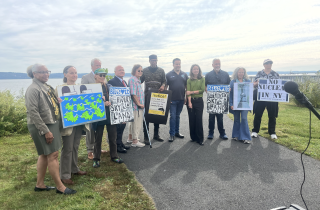

Indian Point Decommission Rally Held in Haverstraw added by Gillian DeStefano on
View all posts by Gillian DeStefano →
You must be logged in to post a comment Login